Production AI engineering studio

From prototypeto production AI.

We build grounded AI systems your team can evaluate, observe and operate—from the first useful workflow to production.

RAG Agents Evaluation Observability
Engineered end to end
Grounded
context
OK AI
Evaluated
output
Illustrated workflowGrounded context
Engineering principleEvaluated output
Explore
Since 2024building applied AI
20+people across the studio
Privately heldindependent by design
Engineering-ledfrom architecture to delivery
Capabilities

AI that survives
contact with reality.

We bridge model capability and production engineering—so the system stays useful after the demo.

01

Production RAG

Source-grounded retrieval with citations, freshness controls and confidence signals built into every answer.

02

AI agents

Reliable tool-using agents with clear boundaries, human approvals and production-ready orchestration.

03

MCP & integration

Typed interfaces that connect models to your systems without turning your architecture into a black box.

04

Evaluation

Golden datasets, regression gates and groundedness checks that make releases measurable, not hopeful.

05

Observability

Latency, token cost, freshness and failure classes surfaced as engineering signals your team can act on.

06

AI automation

Focused workflows that remove repetitive work while keeping ownership and exceptions visible.

Product concepts

Knowledge. Action.
Confidence.

Three focused product directions, built around the same principle: useful AI needs evidence, clear boundaries and measurable behaviour.

Dissertation concept portfolio. These are proposed products based on the studio’s engineering capabilities. Pilot scopes and targets describe what would be validated.

Proposed product · 01

OK Context

Answers with evidence. Context with history.

A proposed internal knowledge workspace that turns approved project documents into cited answers and versioned context for people and AI tools.

For: Engineering leads, support specialists and internal knowledge owners.

Explore OK Context pilot scope
Input
Approved PDFs, project documentation and repository documents with source ownership and access rules
Output
Cited answers, source timestamps, searchable snapshots and a reviewable account of what changed
Pilot boundary
One knowledge domain, up to two approved source types and an agreed set of representative questions.
Proposed deliverables
  • A permission-aware source connector and ingestion pipeline
  • A search and answer interface with paragraph-level citations
  • Immutable context snapshots with semantic change summaries
  • Read-only MCP tools for retrieving approved context
Acceptance targets · to be tested
  • Target: at least 90% of factual answer claims are supported by their cited passages on 100 agreed evaluation questions, assessed by a named reviewer.
  • Target: no cross-role document disclosure in the agreed access-control test suite.
  • Target: every changed source document appears in a traceable snapshot and change report.
  • Target: explicitly decline or request clarification for every unanswerable case in the agreed test set.
Architecture
Extends the site's Java 21 + Spring AI architecture reference: allowlisted collectors → immutable snapshots → retrieval → typed MCP tools → evaluation and tracing.
Maturity
Product concept; architecture reference available
Proposed product · 02

OK Flow

Move work forward with clear approvals.

A proposed operations assistant that classifies incoming service requests, gathers relevant context and prepares a next action for a human reviewer.

For: Service operations managers, support team leads and case handlers.

Explore OK Flow pilot scope
Input
Service requests, approved procedures and read-only records from one ticketing or CRM system
Output
A classified request, an evidence-backed action draft, an approval task and a traceable execution record
Pilot boundary
One operational workflow, one connected system and 50 representative cases tested in a controlled environment.
Proposed deliverables
  • A bounded agent workflow for one request category
  • Typed, allowlisted MCP tools for one business system
  • A human review queue with an explicit action preview
  • An audit trail, retry handling and a manual fallback path
Acceptance targets · to be tested
  • Target: at least 85% correct routing across 50 agreed, manually labelled cases.
  • Target: every action that changes a business record requires and records a human approval before execution.
  • Target: repeated delivery of the same request produces no duplicate state-changing action in the agreed retry tests.
  • Target: every failed tool call creates a visible exception with a recoverable next step.
Architecture
Request → classify → retrieve approved context → propose action → authorised human approval → scoped tool execution → audit record.
Maturity
Product concept; workflow and integration scope proposed
Proposed product · 03

OK Release

See what changed before you release.

A proposed evaluation workbench for comparing prompt, model, retrieval and tool changes against a team's own versioned test cases.

For: AI engineering teams, QA engineers and technical product owners.

Explore OK Release pilot scope
Input
Versioned evaluation cases, reference answers, application traces and two candidate system configurations
Output
A reproducible comparison report, failure clusters, cost and latency signals, and a reviewable release decision
Pilot boundary
One existing RAG or agent workflow, two candidate configurations and 100 representative cases with an agreed scoring rubric.
Proposed deliverables
  • A versioned evaluation dataset and reproducible run configuration
  • A comparison dashboard for factual support, tool use, latency and estimated model cost
  • CI checks for agreed quality thresholds and mandatory regression cases
  • Trace-linked failure reports with a named owner and review history
Acceptance targets · to be tested
  • Target: every run records the dataset version, system configuration and available model identifier.
  • Target: every deliberately seeded mandatory regression blocks the pilot release gate.
  • Target: a reviewer can open the source trace for every failed evaluation case.
  • Target: all included requests report latency and model usage, with cost estimates labelled and missing telemetry visible.
Architecture
Versioned cases + candidate configuration → evaluation runner → deterministic checks and calibrated review → comparison report → release gate.
Maturity
Product concept; acceptance framework proposed
Ways to work together

A clear scope.
A tangible outcome.

Proposed engagement packages for the dissertation model. Timelines are indicative; access, scope and acceptance criteria are agreed before delivery.

01

AI Discovery & Architecture

Indicative scope: 2 weeks

Teams choosing a first AI workflow or deciding whether a prototype is worth extending.

Turn a business problem into an implementation brief with explicit data boundaries, ownership and a testable definition of success.

What the engagement delivers
  • Workflow and stakeholder map
  • Data access and integration assessment
  • Architecture and delivery options
  • Prioritised backlog, cost assumptions and pilot acceptance plan

Outcome: A reviewable go / revise / stop decision for one use case.

02

RAG & Agent Pilot

Indicative scope: 6–8 weeks

Teams ready to test a bounded knowledge or operations workflow with their own approved data.

Implement a working pilot using the OK Context or OK Flow concept, including the integration, review interface and evaluation needed to assess it.

What the engagement delivers
  • Pilot application and scoped connectors
  • Representative evaluation cases
  • Human review and exception handling
  • Evaluation report, source code handover and operational runbook

Outcome: An evidence-backed decision on production readiness and remaining work.

03

AI Release & Reliability Review

Indicative scope: 3–4 weeks

Teams with an existing RAG or agent application preparing a release or investigating recurring failures.

Assess failure modes and implement an initial evaluation and observability baseline using the OK Release concept.

What the engagement delivers
  • Failure analysis and prioritised remediation backlog
  • Versioned regression cases and CI release checks
  • Trace, latency and usage dashboard
  • Incident ownership, escalation and handover guide

Outcome: Visible release risks, repeatable checks and an operational improvement plan.

Architecture reference

Source-grounded
MCP intelligence.

Turning approved project knowledge into citable, versioned engineering context. This is an architecture reference, not a production benchmark or a claim of measured client outcomes.

The challenge
Useful project knowledge is scattered across sources. AI needs explicit evidence boundaries and a way to explain what changed.
The approach
A Java 21 + Spring AI runtime with allowlisted collectors, immutable snapshots and typed MCP tools.
The deliverable
Reviewable context with source citations, semantic diffs and evaluation signals, so engineers can inspect the evidence behind an answer.
  • Allowlisted collectors and immutable snapshots
  • Golden regression scenarios and safety gates
  • Deterministic semantic diffs between snapshots
  • Latency, token usage and cost as release signals
  1. Approved sourcesOnly allowlisted project knowledge.
  2. Versioned contextSnapshots preserve the evidence.
  3. Typed MCP toolsExplicit, reviewable operations.
  4. Evaluation & signalsRegressions, failures, latency and cost.
Engineering standard

Trust is designed in.

Production outcomes start with explicit constraints, testable behavior and signals that stay visible.

01

Grounded

Every output can point back to approved evidence.

02

Measured

Quality, cost and latency are release criteria.

03

Operable

Failures are observable, classified and recoverable.

04

Evolvable

Typed contracts let systems change without surprises.

How we work

Clarity before complexity.

A focused path from a valuable workflow to a system your team can own.

01

Discover

Frame the workflow, risks and useful success signals.

02

Ground

Connect approved knowledge and define tool boundaries.

03

Evaluate

Create golden cases and automated release gates.

04

Operate

Ship with observability, ownership and iteration loops.

About the studio · London, UK

Small enough to stay close.
Built to go deep.

AI engineers, software developers and delivery specialists working together from the first useful workflow to an operable system.

Company scenario for the dissertation. London and a team of 20+ come from the supplied brief. “Since 2024” appears on the existing website. The detailed history, exact team size and funding below are proposed assumptions.

The proposed operating model is a London-based studio of 23 people. Multidisciplinary teams take a bounded AI workflow from discovery through integration, evaluation and operational handover.

The model connects three areas of work: making company knowledge usable with OK Context, moving bounded workflows forward with OK Flow, and assessing changes before release with OK Release. Client engagements and reusable product components support the same engineering practice.

A proposed path, from 2024 to 2026.

  1. An engineering studio takes shape

    In the proposed history, a four-person founding team forms in London to turn document-based AI prototypes into dependable business workflows. The model starts with £200,000 of founder capital.

  2. A repeatable delivery foundation

    The scenario adds £600,000 of external early-stage capital and expands to six people. Work centres on source ingestion, permission-aware retrieval and a repeatable pilot process.

  3. From individual pilots to shared components

    A proposed 14-person team organises reusable knowledge connectors, typed agent tools and evaluation cases into three product workstreams: OK Context, OK Flow and OK Release.

  4. Investment in delivery capacity

    A further assumed £1 million of external capital supports the planned expansion of engineering, product delivery and operational support. Cumulative scenario investment reaches £1.8 million.

  5. A 23-person operating model

    The dissertation models a studio with two delivery pods and a shared platform and evaluation function. The three product concepts provide reusable foundations for scoped client engagements.

People behind the systems

Engineering is a team effort.

A proposed cross-functional team structure with clear ownership of architecture, AI development, product and delivery.

Oleh Kornii’s name and role are supplied by him; his responsibilities are a draft. The other four names and profiles are fictional examples for the dissertation. Portraits are AI-assisted illustrations, including an edited photograph of Oleh Kornii.

James Whitmore — illustrative portrait for the proposed Chief Technology Officer profile

James Whitmore

Chief Technology Officer

In the proposed team, James leads architecture, technical standards and engineering reviews across the knowledge, agent and evaluation workstreams.

Daniel Brooks — illustrative portrait for the proposed Managing Director profile

Daniel Brooks

Managing Director

In the proposed team, Daniel sets the commercial direction, develops partnerships and aligns project commitments with the studio's delivery capacity.

Maya Bennett — illustrative portrait for the proposed Lead AI Engineer profile

Maya Bennett

Lead AI Engineer

In the proposed team, Maya leads retrieval and agent implementation, reviews model behaviour and connects evaluation findings to engineering improvements.

Emma Clarke — illustrative portrait for the proposed Product & Delivery Manager profile

Emma Clarke

Product & Delivery Manager

In the proposed team, Emma translates operational needs into scoped workflows, coordinates delivery and agrees acceptance criteria with the people who will use the system.
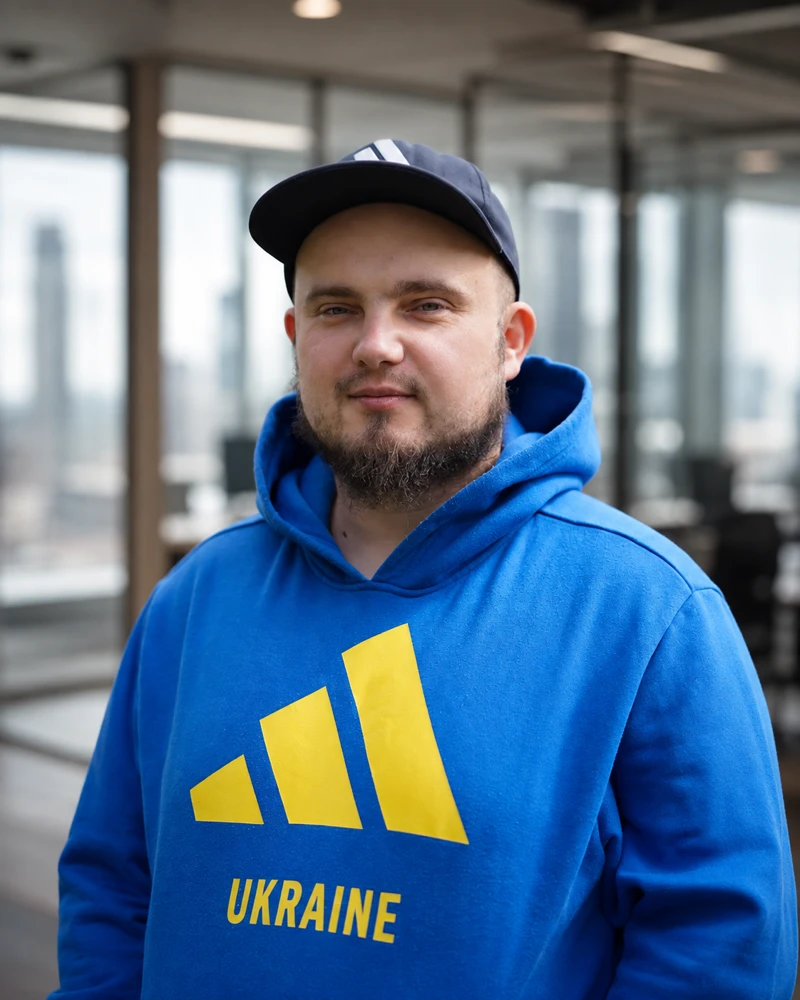
Oleh Kornii, AI Developer — edited portrait supplied by Oleh Kornii

Oleh Kornii

AI Developer

Proposed project responsibilities: build RAG and agent features, integrate typed tools and contribute regression cases for reliable releases.

Connect with Oleh Kornii

Name and role supplied by the user

Explore the full 23-person operating model
Proposed staffing for the dissertation. The five profiles above are included in these counts. Two delivery pods share platform and evaluation support.
FunctionPeople
Managing Director1
Chief Technology Officer1
Product & Delivery2
AI Engineering7
Data Engineering3
Backend & Integration3
Platform & MLOps2
QA & AI Evaluation2
Product Design1
Business Operations1
Total in the proposed model23
Let’s build something useful

Your next step
starts here.

Have a workflow, a prototype or a production problem? Tell us what you are trying to improve.

Email our team hello@okaisolutions.com

Opens your email app. Prefer LinkedIn? Start a conversation there.

Engineering case study

System architecture

Download full diagram
Full source-grounded MCP system architecture

Approved sources → versioned context → typed MCP tools → evaluation and observability. Zoom to read the detail, or download the full diagram.